
See why customers are switching to Gravity
Your Supplier Emissions Data is Already Public
AI agents are freeing sustainability and procurement teams from endlessly chasing supplier surveys. The real unlock is giving your team its time back.
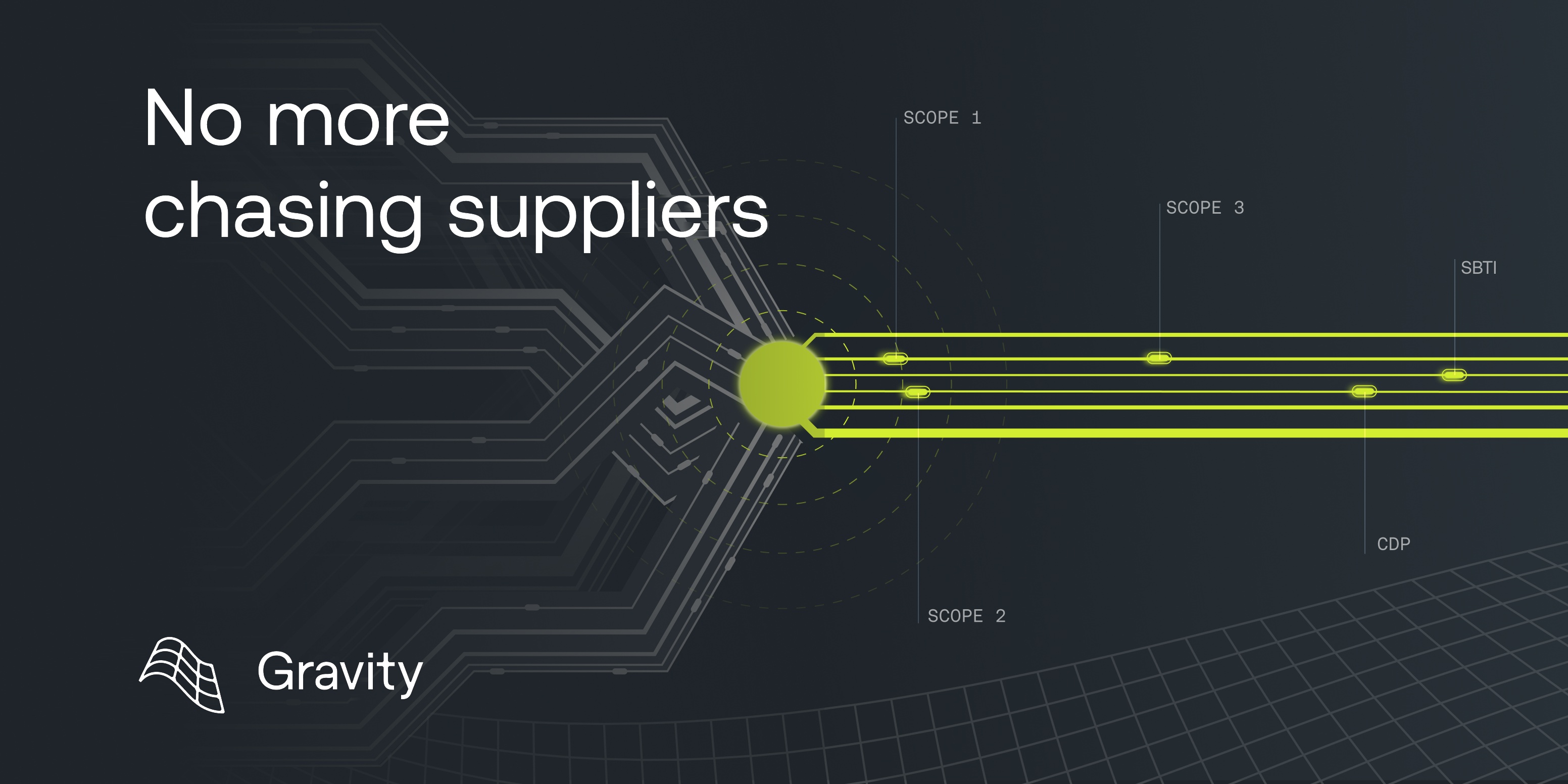

Thousands of companies just finished another cycle of asking their suppliers to fill out sustainability surveys. Response rates were low. The data that came back was inconsistent. And most sustainability and procurement teams spent weeks chasing down a fraction of the information they actually needed to measure, manage, and reduce Scope 3 emissions.
The traditional, survey-based model for supplier data collection is under strain. A better approach is now emerging — one that uses agentic AI to pull data that's already public, cleans it, and reserves human outreach for the set of suppliers that actually need it. The result is a shift from a once-a-year scramble to continuous, automated data enrichment. More importantly, it shifts where sustainability teams spend their time.
Why the traditional survey model is breaking
1. Supplier fatigue is real and compounding. Every large customer is running its own survey. A typical supplier now receives similar requests from multiple customers, each with its own template and cadence. Response rates are falling not because suppliers don't care, but because the volume of requests has outpaced their ability to service them.
2. Many suppliers don’t have the bandwidth to respond appropriately. Sustainability teams at mid-market and small-cap suppliers are often overextended or nonexistent. When yet another survey lands in someone's inbox, there's often no one with bandwidth and expertise to quickly produce a high-quality response. When there is, surveys often demand data buried in utility bills and ERP and billing systems.
3. The data that comes back is inconsistent. Suppliers use different methodologies, different emission factor libraries, and different scopes of inclusion. Two suppliers with nearly identical operations can return Scope 1, 2, and 3 figures that differ by an order of magnitude. Normalizing the data takes almost as long as collecting it, which is one reason most teams end up relying heavily on industry averages and spend-based estimates.
Public disclosures go further than most teams realize
A surprising volume of supplier sustainability data is already publicly available. CDP disclosures, sustainability reports, 10-Ks, corporate sustainability portals, trade association filings, and company websites collectively cover a growing share of most companies’ supplier base — particularly the top suppliers that matter most for Scope 3 disclosure.
The problem has been pulling data out of hundreds of PDFs and inconsistent web pages, normalizing it against a consistent methodology, and keeping it current as suppliers publish new disclosures. That's the work that's historically kept sustainability teams in surveys and spreadsheets instead of driving actual emissions reduction.
What AI agents have unlocked
AI agents fundamentally reshape this work. Agents can monitor a supplier's public disclosures, pull new information as it's published, normalize data against a consistent framework, and flag any gaps or inconsistencies for human review. None of that is new in isolation — what's new is having this data collection run continuously across thousands of suppliers.
This takes supplier data collection from an annual exercise to a process that can run as often as sustainability teams need. Instead of an annual data refresh that's already six months stale by the time you use it, you have a live view of your supplier footprint.
This pattern of AI-accelerated work in sustainability is already showing up across Gravity’s customers across industries. McCarthy Building Companies, one of the largest construction firms in the U.S., has used Gravity to save more than 10,000 hours of manual data work across its jobsites. TTI, Inc., a global electronics components distributor, used the platform to onboard more than 200 locations in 8 weeks and is now doing the work of 8-10 people with a team of two. The underlying pattern is the same across both: when AI handles the data collection and normalization, sustainability teams get their leverage back.
Traditional supplier engagement gets narrower and more useful
Adding AI supplier enrichment to the default playbook doesn't mean abandoning traditional supplier engagement. It means redirecting it. When a large share of a supplier's emissions profile can be assembled from public data, the remaining conversations get shorter, more targeted, and more productive.
The suppliers you actually need to engage are the ones where public data is thin, where the relationship warrants a deeper conversation, or where a joint emissions-reduction initiative is in play. Those conversations move faster because they're not starting from a blank survey — they're starting from an estimate your team already has and wants to validate or improve.
Suppliers respond better, too. Asking clarifying questions about a supplier profile based on traceable data is a different conversation than a 40-question template. Response rates climb, and the interactions feel like partnership instead of paperwork.
How Gravity can help
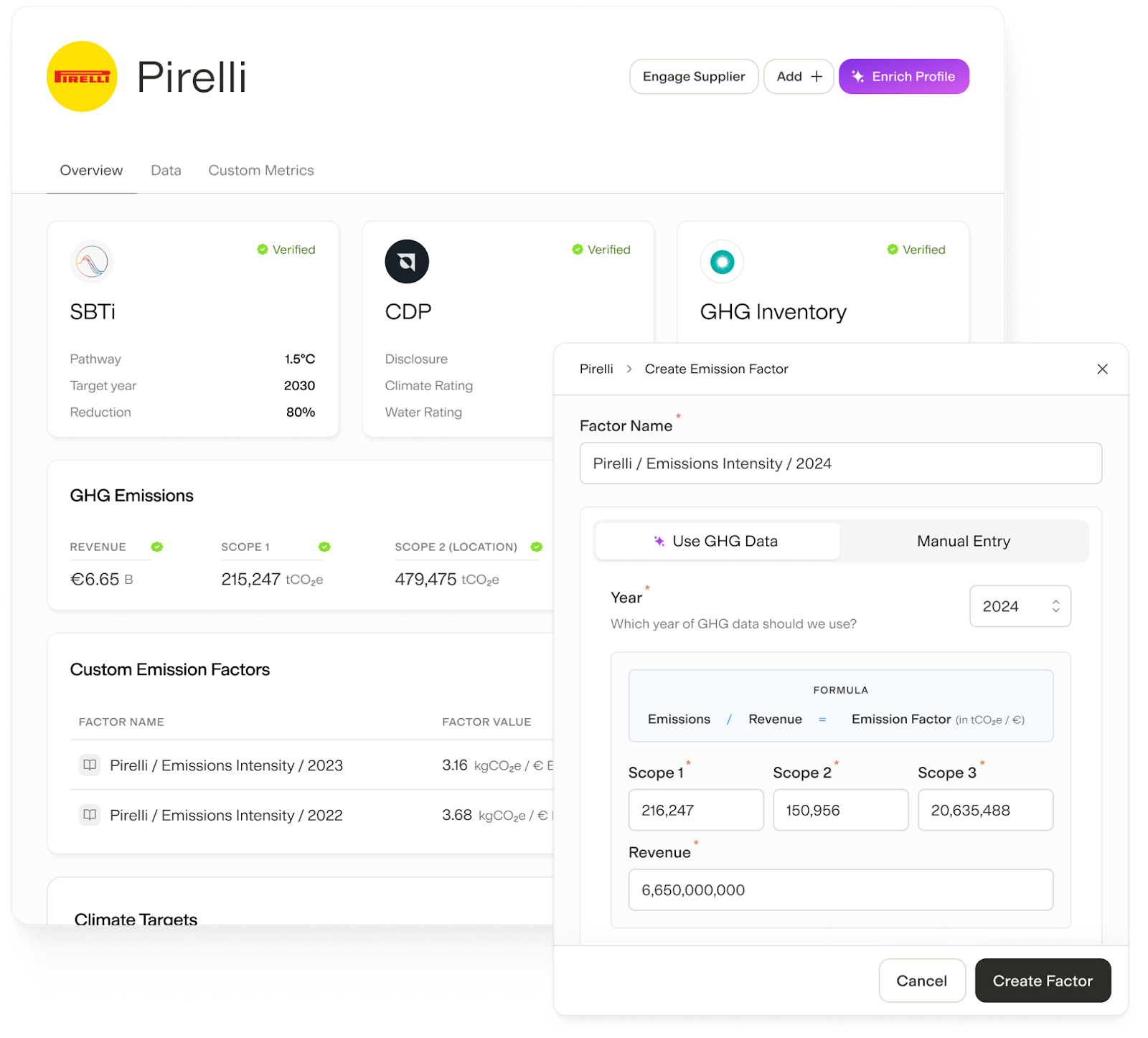
Gravity combines agentic AI enrichment with the full Scope 1 to 3 emissions and energy management platform that sustainability and procurement teams need. Our agents monitor each of your suppliers' public footprints, pulling new emissions data disclosed from CDP, sustainability reports, regulatory filings, and company websites, then normalizing it against a consistent GHG Protocol framework. When data is missing or inconsistent, the platform flags the gap, applies a methodologically sound estimate, and surfaces the specific suppliers where human outreach will move the number the most. Buyers stop treating supplier data collection as a once-a-year survey push and start treating it as always-on infrastructure.
Sustainability teams using Gravity typically see their Scope 3 data refresh cadence move from annual to as often as weekly, response rates on the surveys they still send climb meaningfully, and the hours their team spends on data collection drop by more than 50%. That reclaimed time gets redirected toward the work only a human team can actually do: building reduction roadmaps, engaging the priority suppliers where the conversation matters most, and supporting the disclosure regimes that actually drive decisions.
{{Book a Demo}}
See why Amazon suppliers choose Gravity
Request a demo to see how Gravity makes reporting easy and cost-effective
Download the report to learn more
VerdantixTM Smart Innovators: Carbon Management Software
Curious about Gravity's Energy Management Marketplace?
Book a demo to learn more
Curious about Gravity's Europe expansion?
Book a demo to learn more
.png)
Ready to get off the merry-go-round?
Book a demo to learn more.

Curious about Gravity's CDP accreditation?
Book a demo to learn more.

California's Carbon Reporting Rule
Watch our webinar to prepare for California's new climate regulation

Curious about these features?
Book a demo to learn more.

Be prepared for SECR
Meet with our team, walk through the steps you'll need to take to report, and start a free trial to see how Gravity can help you report with greater speed and accuracy.
See the platform in action
Watch a short video to see why leaders like WM, TTI, and WAF have chosen to work with Gravity to simplify carbon accounting and drive business impact.

Meet with our team, walk through the steps you'll need to take to report, and start a free trial to see how Gravity can help you report with greater speed and accuracy.

Cut down reporting time by 70%
Request a demo to see these features in action and learn how they can save hours of manpower in your next reporting cycle.
Looking to Uplevel Your Sustainability Programs in 2025?
Reach out for a personalized meeting with our climate experts to find opportunities to save time on regulatory compliance, simplify internal communications, and execute projects that deliver real business impact.
Find energy efficiency projects that deliver value
Learn how to reduce energy costs and emissions.
Be prepared for the CSRD
Get in touch to find out how your company should prepare for the CSRD amidst changes to the regulation.


%20(1).png)